Here's the link to my interview on why your breast milk is the best for your own child.
http://www.bfm.my/we-are-what-our-grandmothers-ate-ng-yee-voon.html
Monday, May 30, 2016

Sunday, May 29, 2016
Which is the Best Formula for My Infant?
I
support breast feeding. I support parents who breast feed. Your breast milk is the best for your own
baby.
Having said that, I have also met parents who
decided to stop breast feeding for various reasons. As a dietitian, a counsellor,
and/or a supportive friend, I stood by their choice.
Breast
feeding moms, new or experienced, may go through stages of stress and are not
comfortable to breast milk. They are in dire needs to "supplement"
feed their growing infants, or to replace breast milk completely. We also know
that human milk bank is not culturally acceptable for Muslim moms, and not
readily available for other moms of other races, these parents need an
alternative, at that juncture.
I am sharing this post on how to choose infant
formula or follow up milk for babies who have to stop taking breast milk and
for parents who are worried about the choices they are about to make. I wish
new parents are empowered, guided and can carry on with life. It would be extra
jolly to me, if they come back to breast feed after the initial hurdle.

The Safety to Use Infant Formula in Malaysia
The content of infant food (below 1
year old) and follow up formula (6 to 12 month old) are tightly regulated by
the Malaysia Ministry of Health (MOH). We can rest assured the formula bought
from a reliable source is safe (halal) for our babies.
The
marketing or claims on the formula for children below 1 year old is by far
tightly regulated by law. Soon, the regulation will also cover a wider scope,
beyond 1 year old. That also means, if the label says it's not suitable
for your child age, you shall then consult your pediatrician or dietitian on
what other choices you have.
The Special Ingredients
A
growing numbers of findings have suggested the importance of various groups of
nutrients for fetus or infant development. These are good science and those
that are needed have been fortified in our formula recently. For some others
which fortifications remain debatable, they might have been added into the formula at
safety and presumed effective levels. It's then expected of the parents to make informed choices.
Parents
who could afford nutrients fortified formula or babies who can’t tolerate
regular baby formula, are keen for an alternative or specialized formula, by
choice or by need. So, let's learn a little about these additives that
differentiate the formula.
- Sufficient intakes of omega 3 fatty acids, namely Docosahaexaenoic Acid (DHA) and Arachidonic acid (ARA) have been linked to visual acuity and cognitive performance in babies. Babies absorb these nutrients either through the placenta or the breast milk, accumulate these nutrients in their eye and brain in the 3rd trimester (as a fetus) and during the first 2 year of life.
For baby formula, the recommended doses for infant below six month are
established in Europe, US and adopted by the WHO. They are to mimic the human milk
contents of parents with good intake of such fatty acids. The minimum effective
doses have generally been added into the formulation that is globally known.
For these nutrients, more doesn’t equate better. Parents
don’t have to worry about getting the product with the highest (and often more
expensive) content.
During the second 6 month of life, a diet rich in DHA and AA should
be continued, but experts do not have enough information to recommend exact
amounts of those fatty acids so far. Giving your child a daily diet rich in seaweed or seafood, can increase his DHA and AA intakes. If this target for dietary intake can be achieved, the amount of DHA and AA in formula will be less concerning.
2. Hypoallergenic (HA) formula shall be used for the prevention
of food allergy for infant below 6 months, before any sign of allergy. If either one parent or a sibling of a child has a history of allergic reaction, this baby is at a greater risk to develope allergy. They shall be given HA formula before starting any other form of milk. However the benefit to continue HA
formula after the baby is 6month old is not convincing yet.
A family ought to know that for a baby who has been diagnosed with allergy by a
pediatrician,HA formula won’t help to stop the allergy reaction activated
earlier. An extensively hydrolyzed or amino-acid based formula, depending on
the severity shall be used.
3.
Prebiotic and probiotic fortification creates a gut
environment that is similar to healthy breastfed babies. It may help to reduce
infections and risk of allergy. Early
studies are encouraging, but again the need to provide them in infant formula and follow-on
formula is uncertain yet.
You
may also have heard of neucleotides, Sialic Acid (SA), Selenium, Choline, or
carotenoids fortified formula. There has been some evidence to fortify formula
with them. However, the evidence is not strong and not conclusive yet, especially
for a baby who is growing up well.
Nutrient
discoveries won’t stop here and I believe it is for our benefits. However,
whenever any new information comes out, parents do not have to rush to get the
newest formulation. Usually medical institution or local authorities of developed
countries would come out with guidelines in time to regulate the content in all
formula.
Your own breast milk remains the best food for your child. It is the gold standard of all infant nutrition. When formula information is generally overhwelming, may be parents shall give breast milk another try, switch the focus onto the nutrition for herself.
Monday, April 18, 2016
家里有挑食的小孩吗?
现今社会,为人父母者受的教育比较高,对孩子的付出和要求更高。父母常常为孩子饮食不均而操心,怕会拖累身心灵以及智能的发展。身为营养师,我时常会碰上类似的家庭。
父母的观点
造成挑食这弊端的可以有许多原因。然而,最常见的情况并不是孩子出现了任何问题。依统计,父母缺乏常识与耐性,误解了孩子,错误判断孩子挑食占最多数。
父母应该了解和体谅成长中的小孩需要许多时间和机会学习独立。当中包括认识,然后接受新的或少见的食物。小孩也和成人一样,有自己喜好或讨厌的。如果父母有意培养孩子常吃某某新食物,首先父母需要很有耐心地,让孩子对该食物有个完美的“邂逅”。
再来,让她和它多接触。久而久之,孩子便会喜欢上“它”了!一般来说,小孩需要有最少十个独立的接触,方能接受一个新奇的食物。
病理
有些孩子的的确确有理由针对并抗拒某一类的食物。营养师从病理的角度观察,这一组的小孩一般上会在首几次接触某某食物时,就已经表示出来。一般来说,是在孩子4至6个月大时,开始食用副食品时,就呈现不适的反应。
只要留意一下,父母会发现孩子用餐后,特别哭闹,甚至呕吐,腹绞痛或腹泻等。严重的情况下,长久以后孩子可能面对发育不全的现象。父母如果遇到这种情况,首先该观察并排除环境所造成的不适。比如,用餐的环境,人物,时间,分量,温度等等。仔细观察孩子对那一类食物特别有反应。记录下是什么样的反应。然后,在儿科检查时反映给儿科医生。一般上,医生或营养师会观察一两次后,便可以知道孩子是不是生病而呈现挑食的行为。
生理机能
吃东西需要时间学习。人类是灵长类,一定可以慢慢学会一种动作,一定可以慢慢学会接受新味觉(食物)。
当小孩有能力自己坐起来时,那大约也是孩子接触副食品的时候。头脑,肢体和消化系统已经微妙的发育成熟,准备开饭了。然而,每个小孩都很特别,都不一样。某一些小孩需要婉长的时间学习接受一种新食物。
当中,问题就可能出现在小孩脑部和肢体发育相对的慢。慢慢地拖累延长了其他发育过程。如果父母没有发觉这小孩的特殊需求,而认为小孩纯粹是挑食,那挑食的症状就无法解决。
这一组小孩可能需要饮食治疗师(feeding therapist)或者父母的特别督促。把食物以其性质分类,依孩子口腔,吐咽功能能力范围出发,一步步地展开训练。
心理/习惯
漫漫成长路,饮食习惯及对某食物的印象可能在不知不觉中形成。比如说,孩子几个月大时,在某一次尝试绿色的食物时,不小心被噎到。从此,小孩不再对绿色食物有兴趣,甚至产生抗拒,呕吐的反射反应。长大后,小时候的不快事件早已被淡忘了,小孩却还是不吃任何绿色食物。
偏食有很多原因。所幸,多数时候都可以直接克服。只要监护人稍加耐心,孩子便可以一天天增加他的食物选项。

Thursday, April 14, 2016
Recipe: Apple-y Sunday Snack
Have a Apple-y Sunday! This recipe will entertain the big and the small kids at home.
Try it chilled.
For a local twist, replace the green apple with guava n the berry with fresh rambutan flesh. All fresh fruits is added last, before serve.
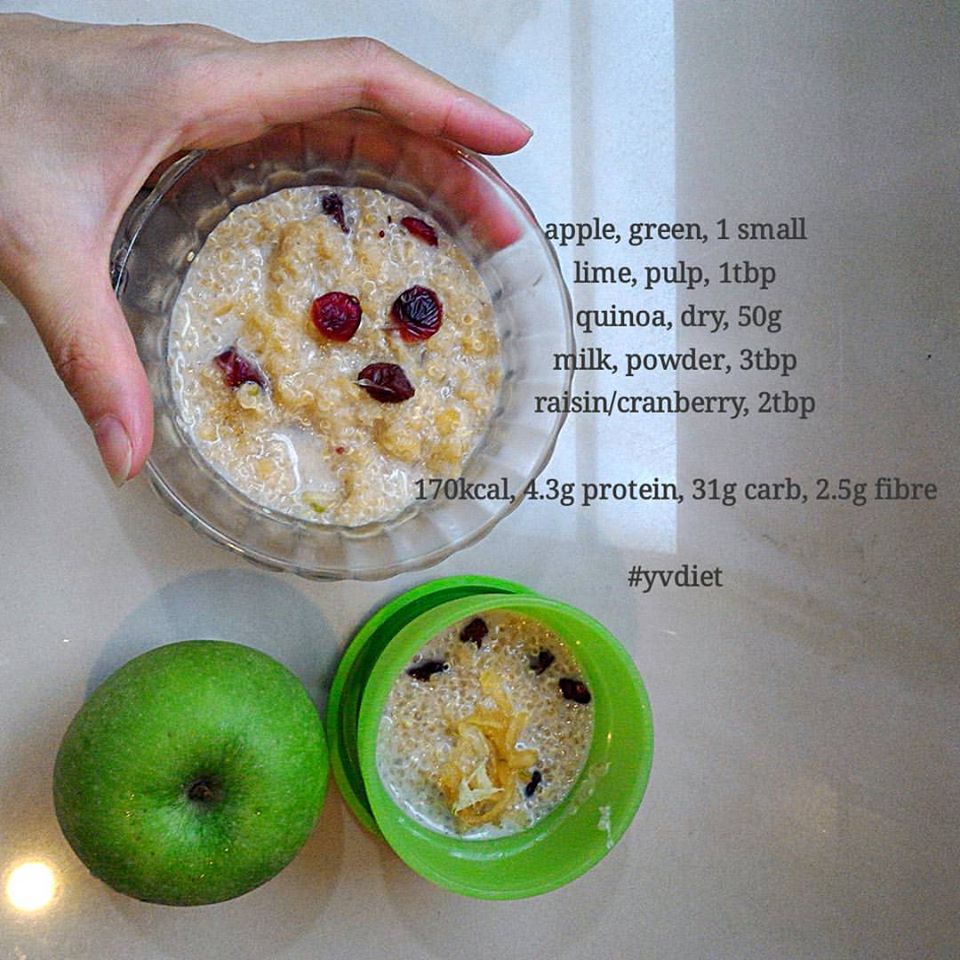
Steps:
1. Boil quinoa in water at a 1:2 ratio.
2. When quinoa is expanded and soften, add raisin, cranberries or dried fruit. Cook for 5min.
3. Remove from heat.
4. Add milk powder, fresh pulps of lime, and freshly shredded green apple. Stir to mix well.
5. Portion into small container. Keep in refrigerator for 2 hours before serve.
Tuesday, April 12, 2016
Understanding Children Behaviors, a Way to Manage Fussy Eater
I was given a great opportunity in 2015 to share some knowledge on feeding children with fussy eating behaviors, particularly those with sensory issues, following my exposure to working with the feeding team.
As a dietitian, working with the multidisciplinary feeding team was a privilege. The feeding team is a resource too scarce to find in Malaysia.
I shared my experience in a nutshell. The way to manage difficulties in feeding children of all ages is through thorough understanding of their thought processes and natural behaviors.
Follow this link for the video record:
https://www.facebook.com/malaysiandietitians/videos/933288113451701/
As a dietitian, working with the multidisciplinary feeding team was a privilege. The feeding team is a resource too scarce to find in Malaysia.
I shared my experience in a nutshell. The way to manage difficulties in feeding children of all ages is through thorough understanding of their thought processes and natural behaviors.
Follow this link for the video record:
https://www.facebook.com/malaysiandietitians/videos/933288113451701/
Monday, April 11, 2016
You and baby weekly meal planners

If you're wondering what to give your baby in her first weeks of starting solids, look no further than our meal planners and recipes.
Our meal planners cover the first 10 weeks of starting solids. Find out how to make eating with your baby easy and a real treat with our planners and recipes:
You and baby meal planners from six months
This article was first published on:
http://www.babycenter.com.my/c1046350/you-and-baby-weekly-meal-planners#ixzz45VLT018M

Subscribe to:
Posts (Atom)